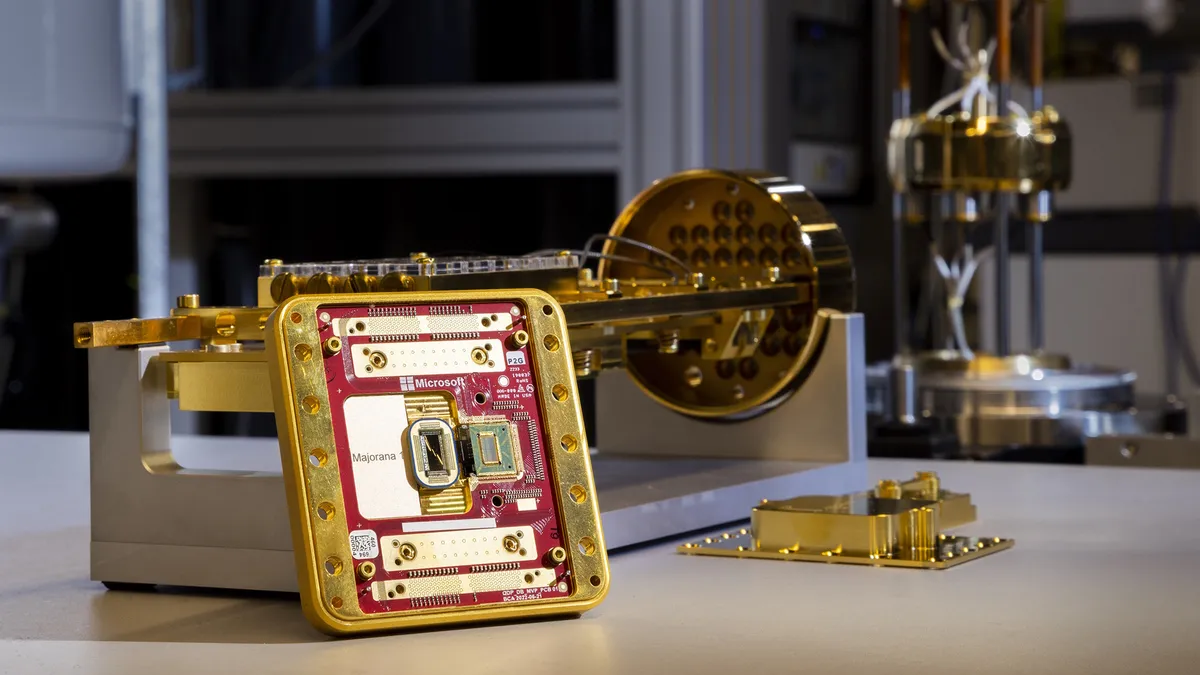
Last month I reported that Microsoft claims its new quantum chip is. I said back then that I would leave it to the brainy big wigs to assess whether this new Majorana 1 chip actually represents the breakthrough that's been claimed. And I'm glad I did, because it turns out there's quite a bit of spicy disagreement over what's actually been achieved here.
Microsoft will be next week, but in the meantime at least some scientists have been pushing back against Microsoft's grand claims. reports that University of Pittsburgh physics professor Sergey Frolov claims Microsoft's work here is "essentially a fraudulent project."
As a reminder, Microsoft's biggest claims were that the chip "leverages the world’s first topoconductor, a breakthrough type of material which can observe and control Majorana particles to produce more reliable and scalable qubits, which are the building blocks for quantum computers" and that this topoconductor has "created an entirely new state of matter."
But prof. Frolov explains: "This is a piece of alleged technology that is based on basic physics that has not been established. So this is H25 a pretty big problem…
"If all your Majorana results are scrutinized and criticized, there is just absolutely no way this is going to be a topological qubit. h25 com สล็อต That leaves kind of one option, that it's… an unreliable presentation. And that's why I say fraud because at this point I'm out of other words to use."
Yet more stuff that I have nary the expertise to even come close to assessing, but there's something about the shots fired nature of some of these debates that has me excited regardless.
As just one example, Frolov says that since a 2018 paper from Microsoft claiming to have detected the majorana particles which was later retracted, "the only improvement there has been is in the quality of the PR campaign, or certainly the level of the claims that they're making. And I would say almost everyone in the field agrees with that."
I'm half expecting a 'yo mama' in response. And Microsoft's response (via Nayek) to Legg's preprint paper does have that kind of air to it, too:

: We dive into the lingo of AI and what the terms actually mean.
"There is a century-old scientific process established by the American Physical Society for resolving disputes. Comments and author responses are reviewed by referees in the journal and eventually published for the benefit of readers. We have not been contacted by the PRB [Physical Review B] editors to respond h25 com เข้าสู่ระบบ to Legg's comment. When we are, we will provide an official response."
In other words, 'meet me outside then'.
I must say that on the face of it Microsoft's claim here isn't unreasonable. Its paper has passed peer review and been published, and if anyone has criticism they can submit it for review and have Microsoft give its best official defence.
On the other hand, this debate does bring to the forefront the nature and alignment (or misalignment) of peer review, expert consensus, and big corpo bucks and media attention.
One potential concern could be that even if Microsoft's claims were later proven to be false or misleading (and as I say, I'm keeping my beak out of that debate) people might have taken them on-board regardless, especially given they've been widely publicised.
But I suppose that would in part be because people like me keep writing about it and scooping over media attention… I'll go sit in a corner and think about what I've done while the big brains figure out who's right and who's wrong about all this majorana malarkey.